Followers

Wednesday, 15 November 2017

HOUSE OF READING


I am writing this post in November, 2017. Ron’s epic reading tour five months ago, and our travels from Nanoose Bay through the Okanagan, the Kootenays and the Rockies to Calgary, and back to Nanoose via Kamloops, the Cariboo, Prince George and the Hazeltons, seem, like the Skeena, the river of mists, to have receded into the shape shifting world of memory. Yet a journey, once begun, seeks an ending . . .

The evening of Tuesday, June 20, found Ron seated at a table in the multi-purpose room in the Prince Rupert Library. The group assembled around him was small. It numbered the librarian, Kathleen, one sprightly senior from the general public, me, and Richard Wilson and his wife, Sharlene. Richard is a stroke survivor and he and Sharlene are the facilitators for the Living with Stroke program in Prince Rupert. Like Ron, Richard’s stroke has left him easily fatigued and reluctant to drive. Fortunately, he is still able to sing and play the guitar and his music has become the central focus of his life. He plays in a band which was to perform the next day at the Aboriginal Day celebrations taking place in Prince Rupert. As we were leaving Kathleen presented Ron with one of the library’s book bags which are decorated with Henry Green’s beautiful black and red stylized drawing of a halibut. The bottom of the bag reads:  Wap Liitsx   House of Reading

Prince Rupert is located in the traditional territory of the Tsimshian First Nation and has been a trading centre for thousands of years. More recently the trade was in sea otter pelts and then salmon. Historic canneries abound here. Today Prince Rupert is a thriving container port, in large part because it is the closest Pacific port for rail traffic going to and coming from Chicago and environs.

Ron gave his final presentation of the tour at a Lunch and Learn session at the Prince Rupert Hospital on Wednesday. It was a lively affair, attended by many student therapists in residence. One student was from New Brunswick, others from Ontario, while the majority were from BC. All had lots of questions and the session lasted long after the lunch hour.

In addition to his “official” duties Ron had a personal reason for visiting Prince Rupert. When he was eighteen he had spent a summer there working at various jobs. (When the rain lets up and the sun comes out it is common practice for people in Prince Rupert to take a “Sun Day” and quit their jobs.) At the end of the summer Ron was hired to work on a drum seiner. His memories of Prince Rupert and his voyage on the fishing boat down the coast to Vancouver have haunted him ever since. So, between and after Ron’s “official venues”, we drove around the town and spent time in the local archives while he reoriented himself and revitalized his recollections. His goal: to write a novel based on his “coming of age” experience.

Our own journey ended with a voyage down the Inside Passage. We had booked a travel package with BC Ferries and had to be at the terminal to board the Northern Expedition at 5 am on Thursday, June 22. We spent the first four hours of the trip sleeping in the cabin we had reserved and the rest of the day soaking up the scenery. As the vessel approached the southernmost tip of Haida Gwaii and Queen Charlotte Sound, we made our way to the back of the boat to enjoy the summer solstice sun set over the Pacific Ocean. Fortunately the sea was calm and the drama of fire into water long. The only distraction was the smell of smoke and the curious sight of vapers. (Why does BC Ferries let smokers have the best viewing area on this run?) The sunset coincided with our arrival at Cape Scott on the northernmost tip of Vancouver Island. The darkening island sent an unspoken promise: HOME. SOON.


Thursday, 14 September 2017

THE PEOPLE of the RIVER OF MISTS


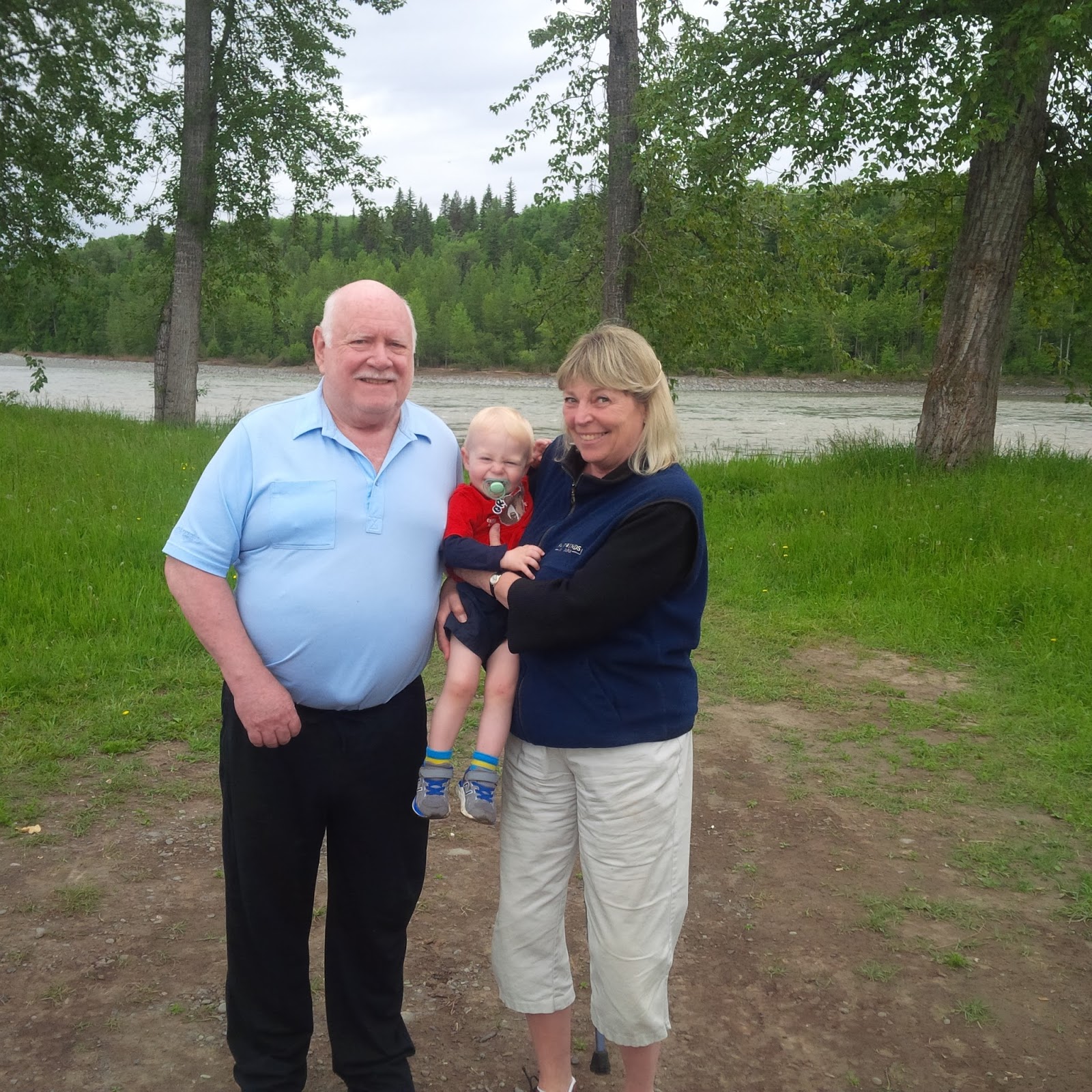
On the morning of June 13, Ron and I left Prince George, excited at the prospect of spending a week with our son, Owen; daughter-in-law, Jen; and little grandson, Lochlan, who live in New Hazelton. Instead of driving non-stop to get to Prince Rupert, or driving non-stop from Prince Rupert to get to Prince George, or heading north on the Cassiar Highway en route to the Yukon and Alaska, as we had done in the past, on this visit we were going to have the time to relax and visit with our family and to explore the area around the Hazeltons, both new and old.
            Our first taste of the exceptional treats in store for us came in Burns Lake where we stopped at the Overwaitea Mall, conveniently located just off the Highway of Tears. We were hungry. In search of nourishment in the mall, we chanced upon the Woodland Bakery where a tray of sausage rolls had just been pulled from the oven by a man with long black hair partially held in place by a pony tail and a hair net. Trusting what our noses were telling us, Ron and I promptly went to the counter of the bakery and ordered four of these rolls. Then we took our snacks out into the corridor of the mall and sat down to enjoy our late lunch.
            “These are the best sausage rolls I’ve ever eaten,” we announced to each other in unison.
            Returning to the Woodland Bakery for a bag of pastries to tide me over for the rest of our journey, I told the owner, a tall woman who, given her grey curls and glasses, looked to be in her early sixties: “These are the best sausage rolls we’ve ever eaten.”
            “I know, I know” she said. “People tell us that all the time.”
            “Well, it’s true,” I said. “And could I please have a chocolate éclair, a cream puff and a sugared doughnut?” I asked. (NB These were for me and NOT for Ron who is careful about what he eats.)
            The most outstanding geological feature of New Hazelton is, without doubt, Mt. Hagwilget, the northernmost peak in the Rocher Déboulé range. This mountain ascends, seemingly vertically, up its 6811 feet to crest in a spectacular arête, or sharp mountain ridge. Owen and Jen’s house sits near the base of this mountain which completely blocks them from the sun for two months during the winter. New Hazelton is surrounded by numerous mountain ranges—e.g. the Nass, the Kispiox, and the Bulkley, with its summit in the Seven Sisters Peaks.
            The area is also famous as the Totem Pole Capital of the World. It is the traditional territory of the Gitxsan peoples who have lived in the area for thousands of years and whose name means “the people of the river of mists.” The ancient village of Ksan is situated at the confluence of the Bulkley and Skeena Rivers in Old Hazelton. The houses which make up the historical village and museum form a single line, with the buildings facing the Bulkley River, and whose large decorated house fronts and poles are visible to anyone approaching from the river.
(Hint: To view this special site you could cut and paste the following link in your browser:  ksan.org  NB I didn’t have any film in my 35mm Minolta. In fact, I didn’t even have my camera with me on the trip. Perhaps I thought I would have enough to pack with all the books and our bags? However, I did kick myself for forgetting to pack binoculars.)
            Famous is a relative term. As the Ksan Museum brochure makes clear, the survival of the Skeena area’s precious artifacts and buildings is due, in part, to the region’s escaping the effects of colonization. Thanks to their isolation for much of their history, the Gitxsan were allowed to continue their traditional life style. Even today the area remains pretty much “off the beaten track.”
Fortunately for Ron and me, Owen and Jen know most of the local sites. They took us on numerous outings, the most memorable of which was our trip up the Cassiar Highway to the village of Gitwangak with its totem poles still in situ; to the National Park site of Battle Hill where a legendary Gitxsan chief held off all invaders, including the Haida; and to 37 Grille for lunch where Ron and I soon remarked in unison, “This is the best potato leek soup I’ve ever eaten.” Owen, Jen and Lochlan were too busy with their own meals to reply. However, upon leaving the diner, we did take home sample slices of the Black Forest Cake, the Chocolate/Caramel Explosion, the Cheesecake and the Maple Walnut Cake. (fyi Please cut and paste:  37 Grille, Kitwanga )
Our favourite outing was Anderson Flats, near the confluence of the Skeena and the Bulkley, on the opposite shore from Ksan. Here we could sit by the rivers, revel in the scenery, or stroll along the road, while Owen’s dog, Gus, ran free. A place to seek and find!


Ron, Lochlan, Pat and the Skeena
&
Lochlan and a misty mountain


Tuesday, 5 September 2017

NO ROOM at the INNS


Rain pounded our windshield as Ron and I drove through the June monsoon out of Calgary, all the way to the centre of Canmore. Here we were met at the side of the main street by Ron Deans who was wearing a yellow rain slicker over his shorts and T-shirt and standing under the protection of a golf umbrella. He guided us to his and Dianne’s nearby townhouse. We gratefully took shelter in their living room where a welcoming fire blazed in the fireplace. After the ‘busyness’ of the public events in Calgary we sat back and relaxed, feeling immediately at home. We helped ourselves to the generous array of buns, cheeses, meats, fruit and condiments spread out on the dining table, and washed down the delicious late afternoon meal with a glass of local craft beer.
Dianne was the first person to write to Ron after the publication of The Defiant Mind. She had found his book helpful and inspirational and she wanted to talk to him about her stroke. She first proposed they meet on Vancouver Island last fall, but her trip west had not worked out as planned, so Ron had put a visit to the Deans on his Stroke Month itinerary.
            Our conversation soon turned to the reservations Ron and I had NOT made for accommodations for the night. Apparently Albertans head for the Rockies in droves every weekend, monsoon or no monsoon. Dianne’s phone calls soon confirmed that all the hotels, motels and B&B’s in the surrounding area were full. Canmore, being just outside Banff Jasper National Park, is a favourite recreational destination. Given that there were no rooms to be had at any of the inns, the Deans graciously invited us to spend the night with them. We spent the rest of the evening enjoying a lively conversation and went to bed grateful for their generous hospitality.
            Ron and I awoke the next morning to discover the rain had stopped and that we were in the midst of towering mountains draped in white, fresh-fallen snow. A message from Noreen Kamaal arrived announcing that the two-day closure of the Trans-Canada Highway, caused by flooding just west of Revelstoke, had been lifted and the road to Kamloops was now open. After breakfast, and after promising to renew a budding friendship with Dianne and Ron, we resumed our travels, heading west through the Rockies. We were soon past Banff, Lake Louise, Golden and the summit of the Rogers Pass. We stopped briefly at Tim Horton’s in Revelstoke for a mandatory coffee and doughnut. Back on the Trans-Canada we were surprised not to encounter any single lane traffic for road repairs caused by the flooding. In fact, there was no sign of the road closure at all. The debris had been cleared away and there was no obvious damage to the road or to a bridge.
            When we reached Salmon Arm the sun was hot. The temperature on the dashboard of our car read 31 degrees. The water level in Shuswap Lake was exceptionally high from the deep winter snowpack, and it was still cresting from the heavy spring run-off. The last hour of our journey to Kamloops passed quickly. As soon as I smell sagebrush I immediately feel at home. I graduated from Kam High in 1965 and played basketball for the Red Angels. The Red Angels’ rivalry with the Salmon Arm Jewels was legendary in the sixties as the two teams duelled their way to league and district titles, competing all the way to the finals of the provincial championships which, way back then, were held in the old Women’s Gym at UBC. Being on my “home court” I calmly drove us to the main hotel in the centre of town where there was still room for us at the inn.
            The next morning we awoke refreshed. Ron had another Lunch and Learn Session booked for the Royal Inland Hospital at noon. At this gathering Deb Rusch did her “Living with Stroke” presentation “remotely” via teleconference. Ron followed by speaking about his stroke experience and his suggestions for treatment and therapy in answer to questions posed by the thirty plus therapists. The session was concluded by host Jeff Frison at 1 PM precisely. After chatting with a number of therapists in the hall outside the lecture room, Ron and I were able to resume our travels a little earlier than expected. This time, however, I was able to drive this leg of our journey north, through Clinton, One Hundred Mile House, Lac La Hache, Williams Lake and Quesnel, through moose country, secure in the knowledge that we had already booked a reservation at an inn in Prince George.
            

Wednesday, 23 August 2017

ENTERING THE SQUARED CIRCLE


At the Stroke Recovery Association of Calgary’s annual convention at the Coombs Theatre in the Foothills Medical Centre in Calgary on Saturday, June 10th Ron was bottom of the card. Thanks to the advice of locals, and thanks to the ride provided by Donna Hastings, who picked Ron and me up at the hotel and let us off at the front door of the hospital, I did not have to navigate, drive or park and we arrived with ample time to spare. The Foothills Medical Centre is undergoing massive re-construction and parking is a nightmare, particularly for people with disabilities. Some people I spoke to even questioned the wisdom of choosing the Coombs Theatre, the SRAC’s usual venue, for this year’s convention. Possibly a hockey rink might have been a better choice? suggested some.
By 10 am Ron had made his way down the stairs to the podium in the large lecture room and was seated at a table behind a microphone. Vicky Jones, the Association’s President, made her opening remarks, introduced Ron and the convention was officially under way. Ron’s audience was half the size of previous years. Given the parking situation, only 100 people were in the audience. 200 people is the norm, a number corroborated by the generous amount of food later provided at lunch.
            For the first time on the trip I was unable to hear Ron’s presentation. I was outside the theatre in the lobby seated behind a table displaying bookmarks and copies of The Defiant Mind. This table was next to one of two entrances to the theatre. The only time I was able to catch a peak inside was when late arrivals opened the doors to let themselves in. Ron must have been “on form” during his presentation because book sales throughout the day were brisk. Occasionally I would hear the sounds of rippling laughter, and at 10:45am it was impossible to miss the sirens and the announcement that FIRE ALARM TESTING IS NOW COMPLETE.
            However, as I mentioned, Ron was not the main event. The guest speaker with this honour was Bret “The Hit Man” Hart, famous in the international world of professional wrestling. He was due up on the SRAC’s card at 1pm, after lunch. Hart is also known as “King of the Ring” or “Master of the Squared Circle.” He has held the World Wrestling title (in some or all of its professional associations) seven times and numerous other championships over a span of five decades from the 1970’s to the 2010’s. The son of a famous, Calgary wrestling dynasty, he is well-known locally for his wrestling exploits and for his support and endorsement of the Calgary Hitmen, who play in the Central Division of the Western Hockey League.
What is not so well known is that Bret Hart suffered a stroke in 2002. Although he was completely paralyzed on his left side for a time, he was able to return to the ring in 2003 after recovering his ability to bench press 300 pounds. Yet he still suffers from the emotional after-effects of his stroke. The double doors to the lobby were twice thrown open when a gentleman from the audience came out and grabbed a handful of napkins left over from lunch to give to Hart to help him stem the tears that fell non-stop throughout his address. Ron attended and confirmed that Hart had given a heart-felt and moving speech.
For me, the most emotional part of the day came later in the afternoon when Ron and I met the husband of a woman who was a patient on the stroke ward in the hospital. Word of all the tasty treats, available FOR FREE in the lobby of the Coombs Theatre, had spread there and a couple of the nurses had come down to fill up trays to take upstairs for staff, family and patients. The husband appeared to be in his late forties and his wife was probably close to the same age when her stroke had hit a few weeks earlier, a stroke which had left her “locked in.” Even at the world’s foremost stroke treatment centre some strokes cannot be helped and they continue to take life-shattering tolls. After her stroke, the only parts of her body this woman was able to move were her eyes. With the help of a computer and her eyes she was able to communicate some of her needs and wants to her husband and to the therapists who daily move her legs and arms to keep her large muscle systems active. Her husband was hopeful that new discoveries in mind-machine interface (MMI) might soon be available to help his wife, particularly as her neurologist was about to head to Geneva for an international conference where the most up-to-date findings in this field would be shared.
All stroke stories are emotionally powerful, but this gentleman’s was the most moving Ron and I had ever listened to. The most beautiful description we have read of what it’s like to be “locked in” is The Diving Bell and the Butterfly by Jean-Dominique Bauby. After his paralyzing stroke, Bauby dictated his memoir by blinking his left eyelid (his right was sewn shut) in response to the correct letter pointed to by a speech therapist using a French language frequency-ordered alphabet. The composition took ten months of four-hour daily sessions. Bauby would compose and memorize a passage during the night and dictate his text the following day. On March 6, 1997 the book was published. Bauby died three days later.
By 3 pm Ron and I were ready to leave. Thanks to a ride from Bev Culham, Manager of Health Promotion for the Heart and Stroke Foundation, we were able to arrive safe and dry at the hotel where our luggage was waiting for us at reception. Once behind the wheel of our trusty Toyota, luggage intact, I was able to navigate the twists and turns of the service road with all the savoir faire of a native Calgarian. Quickly out of the maze we found ourselves on TransCanada Number One, heading west. Even though we were late for a rendezvous in Canmore, with Dianne and Ron Deans, I drove slowly through the heavy traffic heading for the Rockies ― through the torrents of a downpour ― known by locals as The June Monsoon.


Wednesday, 19 July 2017

HEART and STROKE


At 11:15 am on June 8th Ron and I got in our silver Toyota and headed for the Heart and Stroke offices in Calgary. Just to set your minds at ease, let me assure you that I had first consulted Google Maps in the hotel business area and had directions to our destination printed out. In addition, I had charted the route on my 2017 map of the city of Calgary. The distance was comparatively short and my call to Kristine Skogg, CEO Donna Hasting’s assistant, earlier in the morning had ensured that we would be able to unload the books Donna had ordered for each of her managers in the back alley behind the red brick building which houses the Heart and Stroke offices. All went as planned. Ron and I even got an escort to the parking lot where our Handicap Parking Permit was immediately put to good use.
            Ron and I then had the privilege of meeting and talking to Lou and Frank Nieboer. The Nieboers have been married for fifty years, an admirable record made all the more remarkable given that Lou had a serious stroke forty years ago when she was just thirty-four. Today she still bears the effects of her brain attack, but she insists on walking without a cane, although she does lean on Frank’s arm. However, the capacity she misses the most is her biting wit. Somehow her cutting repartee is still missing in action, but, like every other ability she has fought to regain, she is determined to rediscover it as well. Obviously the Nieboers have been a terrific team. Frank is the name-sake and recipient of the first “Heart & Stroke – Heart of Gold Volunteer Award” for exemplary long-time volunteering as Chair of the Alberta Board, member of the Heart and Stroke Foundation of Canada Board, founder of the Alberta Stroke Recovery Association and numerous other contributions. Both Frank and Lou have worked tirelessly to increase awareness and promote stroke recovery in Alberta and across Canada. Their devotion to each other and their work is inspirational.
            After lunch Ron opened his presentation by reading the passage from The Defiant Mind which describes his encounter with a fellow stroke survivor after a therapy session. Although the passage is long I think that it is worth quoting parts of it here, for it (and a couple of other passages which Ron read) generated a lot of insightful questions and discussion about what constitutes effective therapy for stroke survivors. The feedback from Ron’s presentation was very positive with fifteen out of seventeen of the Heart and Stroke Managers rating it the highlight of their Learning and Development Day.

I noticed a woman who had been admitted to the rehab unit around the same time as I was, sitting on one of the blue-matted exercise benches. The gym had emptied and was quiet, the way a museum can get near closing . . . The woman’s head was downcast and her posture was one of total defeat. Before I had my stroke I probably would have turned away, quietly, and left the room.  . . .  She was slumped over as if she wanted to sink through the floor. I sat down beside her and rested my elbows on my knees. This was difficult because my right arm still wouldn’t bend the way it was supposed to and still caused me considerable pain.  . . .
     For over a minute we just sat there staring at our feet, waiting, waiting as you do for the tide to come in or for the sun to set, waiting for the right moment to speak. Everything about the way she held herself worried me.
 . . .  Then I noticed tears running down her cheeks.
     She was pale and her face was carved into the sort of chunks you sometimes see in a Francis Bacon or Picasso portrait. She had a modest beauty, one I suspect she had been unaware of or unconcerned about throughout her life.  . . .  She had two sons and a husband who visited her daily. She was one of the lucky ones. Doted on, from what I could tell.
     . . .
     “You okay?” I asked.
     A foolish question, but I knew I needed to get her to talk.
     “Yes.”
     She gave me a quick glance.
     “No.”
     Now she studied me. Her grey eyes looked hollowed out and seemed to have sunk back into her skull over the past few weeks.   . . .
     “You’re doing so well,” she said. “I’ve been watching you.”
     She tried to smile, but the effort it took was too great, and her lips collapsed back into a grim line.   . . .
     “It’s so difficult,” she said. “I can’t do what you do and we’ve been in here about the same length of time.”   . . .
     “It’s impossible for you to see how you’re doing. You can’t see yourself,” I insisted. “You have to be convinced that you’re making progress. Then you will,” I said.
     I understood this despair. I had gone through this conversation with myself many times. Only other stroke survivors knew what you were going through, but there just wasn’t a vocabulary adequate to describe the ebb and flow of emotions.   . . .
     “I’ve tried so hard. I do everything they ask of me. But I still need the wheelchair.”
     “Every stroke is different,” I said, repeating the one tired answer that remains a constant in stroke dialogues, the one response which she didn’t want to hear from me, not from someone who was actually living inside a stroke.  . . .
     “It takes time,” I said, fumbling over my words,… so much time for all of us. You just can’t give up.”
     “Before the stroke I had two heart attacks,” she said. “Compared to this they were a piece of cake.”
     Then a sad look seeped back into her eyes.
     “I thought it would be the same. After both heart attacks I was back on my feet within a month or two. Not with this, though. I can’t see a way out.”
     As if sensing danger, she visibly recoiled. Like a snail, withdrawing into its shell. She gave me her hand which was cold and bony. Then I felt her body shiver and stiffen, her lungs fill, her eyes stare resolutely into mine, and it was then that I knew that, despite her apparent despair, she would never give up. She was one of those people who in the face of terror find the strength to be brave.                                
     “I just have to accept the fact that I’ll never be the same. I’ll never be the same person I was,” she said. “Part of me has died.”
     She paused to try to take in fully what it was she had just admitted to herself.
     “And I must remind myself that I can’t do what you do,” she added. “As you say, we’re all different. Our brains are different.”(pp. 44 – 47)                           

                                                                                                                                                    
After a short break Kate Chidester made a presentation on “Fueling the Brightest Research” and Dr. Hank Duff spoke about “Why Heart and Stroke Research is So Important.” He talked about the seminal effect the research grants he and some of his colleagues had received from the Heart and Stroke Foundation early in their careers. This funding had encouraged the establishment of a gifted team of heart researchers and specialists in Calgary. The freedom that these scientists were given in their research allowed for the development of a meritocracy, which, through self-selection made significant and serendipitous discoveries.
            Calgary, it seems, is doubly blessed with world class people in BOTH heart and stroke.
              In answer to a question about whether or not specific areas for research funding should be identified Dr. Duff paused to consider his answer.
“No,” he finally replied. “As in all areas of human endeavour, people learn and progress by making mistakes and we must always allow researchers the freedom to fail and thereby to learn.”
            Dr. Duff’s invitation to speak at the meeting had also been part of a ruse to get him to attend. Unbeknownst to him, he was going to be presented with the “Frank Nieboer – Heart & Stroke Heart of Gold Award” by Frank himself. Dr. Duff is the third recipient of this esteemed award since its inception in 2007.

Ron also got a tribute of his own after we got home from our Stroke Month Saga on June 24th . He received a thank you card inscribed with the following quote:
           
“Ron is insightful about stroke and inspirational to stroke survivors, care givers, volunteers & all those who work in this space.”
           
                                                                                    Donna Hastings


Thursday, 13 July 2017

Stroke Month Saga, con’t: CALGARY, Alberta


On Monday, June 5th Ron and I proceeded east on #3, the Crowsnest Highway. The highway takes its name from the Crowsnest Pass in the Rockies where the road crosses the Continental Divide between BC and Alberta. After Ron’s talk at the East Kootenay Regional Hospital we spent the night in Cranbrook before proceeding to Fernie where we had complimentary accommodation thanks to the hospital staff in Cranbrook. In Fernie we visited with Randal Macnair and Carolyn Nikodym of Oolichan Books, which Ron had founded in 1974. In 2010 Randal bought the press and moved it to Fernie but Ron remains involved as an editor. Both visits, to Cranbrook and to Fernie, were special. The people and the scenery were splendid and between the venues we were often treated to the sight of large deer with very big, brown ears. Logically enough, this species of four-legged forager is called the mule deer.
However, it is not my intention here to dwell on descriptions of the flora and fauna or geological phenomena such as the Frank Slide. Nor will I comment on my faux pas in consulting a map of BC and Alberta published in 1998 when planning our route from Fernie to Calgary along Highway #22. Nor will I describe the fits of frustrated frenzy the author of The Defiant Mind threw when he realized that he was headed back to the Rocky Mountains and not to Calgary. Also, I will omit any mention of the difficulties one is likely to encounter when asking for directions at gas stations in Calgary. Suffice it to say that I did not encounter a local, at least not a local whose first language was English and who knew the city like a chuck wagon driver at the Calgary Stampede. I shall also refrain from describing the logistics involved in arriving at 1804 Crowchild Trail, the address of the Best Western Plus Village Park Inn, where we had reservations in hand, my cousin Cheryl being away on a hiking tour in the bucolic Tyrolean Alps. I shall merely note that when the weary traveller arrives at the above address, he or she will whiz by the aforementioned hotel, which can only be accessed by a service road known only to locals in the know. Instead, I shall simply remain grateful that somehow we found our way to the hotel, marriage in tatters but luggage intact, and happy in the knowledge that it was only 4pm; that Ron did not have to be at the reading at Shelf Life Books until 7pm; that Noreen Kamal and her husband were picking us up at the hotel at 6:30pm; and that I would not have to drive.

Recognizing that June was Stroke Awareness Month, the event at the bookstore had a unique format. Ron’s reading was complemented by Dr. Noreen Kamal, a Researcher and Adjunct Assistant Professor at the University of Calgary, the engineer who is responsible for implementing the world-leading stroke treatment now available throughout Alberta; and by neurologist, Dr. Amy Yu, who graciously stepped in on short notice for Dr. Michael Hill who had been called away to Hamilton and Toronto. The women were there to comment on stroke and to answer questions from the audience. The answers they gave were extremely enlightening, all the more so because their Department of Clinical Neurosciences at the University of Calgary is world renowned. Dr. Hill and his team led the international research and randomised trials for endovascular thrombectomy for large vessel blockages in ischemic strokes. Using this procedure a person suffering from a clot in the brain has a tube inserted into a blood vessel in their groin which can then be sent all the way up into the brain where a stent is released into the blood clot. Then the stent and the clot can be pulled back down the tube and out the blood vessel in the groin. Doctors Kamal and Yu are intimately familiar with all aspects of stroke treatment and understand how and when endovascular thrombectomy may be applicable and how effective the treatment can be in substantially reducing the disabilities which typically result from strokes. Given the diversity of people in the audience–poets, writers, caregivers, stroke survivors and readers–the event was exceptionally informative and enjoyable. A big thank you to poet Tyler Perry, author Betty Jean Hegerat and Shelf Life Books for arranging this evening and to Bob Stallworthy for reading some of his powerful poems written from the point of view of a caregiver.


Tuesday, 11 July 2017

IPPY UPDATES


The July 2017 Newsletter of the Independent Publisher has just featured a review of The Defiant Mind. To read “Once Upon a Time an Author Had a Stroke” click on the link below:


And, if you are interested, the review is also mentioned in Jim Barnes Editorial: